From Investment Clubs to Prediction Markets: How Fish Pools & Fish Schools Unlock Private Market Liquidity

· 3 min read
Fish Network
Fish Network Team

Private markets have always been powerful—but inefficient.

To participate, you typically have to:

  • Lock up capital for years
  • Accept limited liquidity
  • Operate with little real-time price discovery

And if you don't invest?

You're left on the sidelines—with no way to express a view.

Fish Network changes that.

The Missing Primitive in Private Markets

In crypto, perpetual markets introduced a breakthrough:

You don't need to own an asset to gain exposure to it.

This unlocked:

  • Continuous trading
  • Global access
  • Real-time price discovery

But private markets never had the infrastructure to support this.

Until now.

Fish Schools: The Strategy Layer

Fish Schools are on-chain, legally structured investment clubs where communities:

  • Pool capital
  • Vote on investments
  • Share returns

Each School represents:

  • A curated portfolio and a trackable performance history

But on their own, Fish Schools are still bundled structures—similar to funds.

To unlock liquidity and prediction markets, we need something more atomic.

Fish Pools: The Financial Primitive

Fish Pools are the core building blocks of Fish Network.

They are:

  • Programmable, tokenized units of exposure

Instead of one monolithic fund, a Fish School is composed of multiple Pools:

  • A Pool for each startup investment
  • A Pool for treasury or stablecoins
  • A Pool for hedging or synthetic strategies

Each Pool:

  • Tracks its own performance (NAV)
  • Issues a token representing exposure
  • Can be independently priced and traded

From Bundled Funds to Modular Markets

This shift is critical.

Without Pools:

  • Private investments are opaque and illiquid
  • Entire portfolios must be bought or sold
  • Derivatives are nearly impossible

With Pools:

  • Each component becomes:
    • Priceable
    • Tradable
    • Composable

Private markets gain a clean "underlying" for financial products.

Unlocking Prediction Markets on Private Assets

Once Fish Pools exist, something powerful emerges:

You can build markets on top of performance, not ownership.

Instead of asking:

"Do I invest in this startup?"

You can ask:

"Will this Pool outperform?" "Will this Fish School generate 2x returns?" "Which strategy will win?"

And crucially:

You can trade those beliefs.

Synthetic Exposure Without Ownership

By tokenizing Pool and School performance, Fish Network enables:

  • Long/short exposure to private portfolios
  • Perpetual-style markets on investment strategies
  • Relative performance trading between Schools

All without:

  • Owning the underlying assets
  • Locking capital for years
  • Participating in governance

Private markets evolve into:

  • Continuous prediction markets on investment outcomes

A New Financial Stack

Fish Network introduces a modular system:

  • Fish Pools → Atomic units of capital and exposure
  • Fish Schools → Governance and strategy layer
  • Synthetic Markets → Tradable performance (perps, derivatives)
  • Prediction Markets → Collective intelligence on outcomes

Each layer builds on the one below.

The Path to Liquidity

Traditionally:

  • Liquidity comes from rare secondary sales

With Fish Network:

  • Liquidity is explicitly priced, gated, and distributed across pools and schools
  • Member-led auction systems are designed into the platform

Pools make assets:

  • Smaller
  • Standardized
  • Tradeable

Which allows markets to:

  • Price performance in real time
  • Enable instant entry and exit
  • Aggregate global demand

Why This Matters

This model doesn't just improve access—it transforms the system.

It:

  • Unlocks liquidity in historically illiquid markets
  • Enables real-time price discovery for private assets
  • Separates investing from speculation
  • Turns portfolios into market primitives

The Future of Private Markets

Private investing won't stay locked and opaque.

It's becoming:

  • Modular
  • Transparent
  • Liquid
  • Predictable

With Fish Pools and Fish Schools working together, we move from:

Static capital allocation

To:

Dynamic, global prediction markets on investment performance.

Why Healthtech Venture Capital Breaks at the Earliest Stage and How Fish Schools can help fill the Capital Gap

· 12 min read
Fish Network
Fish Network Team

The Structural Problem: Venture Capital vs Biological Reality

The failure of venture capital in life sciences is often framed as a problem of complexity or risk. That explanation misses the deeper issue. The real problem is structural. The technical and regulatory realities of healthcare innovation are fundamentally misaligned with how modern venture capital is designed to operate.

Drug development, diagnostics, and advanced medical technologies do not follow the fast, iterative cycles that venture capital favors. Instead, they require years of laboratory research, preclinical validation, manufacturing development, and regulatory preparation before any meaningful signal of success can emerge. According to the U.S. Food and Drug Administration, the process of developing and approving a new drug is a multi-stage journey that can take more than eight years before reaching approval. Independent research published in Journal of the American Medical Association estimates that the median capitalized cost of bringing a single drug to market is approximately $1.14 billion, including failed attempts. Data from Biotechnology Innovation Organization further highlights the challenge, showing that only about 7.9 percent of drug candidates entering Phase I trials ultimately reach approval, with Phase II representing one of the most significant failure points. On average, the journey from early clinical trials to approval can take more than a decade.

This creates a fundamentally different capital requirement. Life science startups need funding not to scale proven products, but to generate the proof itself. Early capital is used to answer foundational questions about whether a therapy works, whether it is safe, and whether it can navigate regulatory pathways. In other words, capital must come before validation.

Venture capital, however, has evolved in the opposite direction. It is increasingly optimized for speed, shorter feedback cycles, and early indicators of traction. Investors now prioritize clearer paths to revenue, faster iteration, and more predictable exit timelines. As a result, they are deploying capital later, once key risks have already been reduced. Industry data reinforces this shift. Insights from McKinsey & Company show that Series A rounds now account for a significant share of biotech venture activity, indicating a preference for more mature opportunities. At the same time, Silicon Valley Bank reports that investors are writing fewer checks and taking longer to close deals, while BioCentury notes a decline in early-stage funding rounds despite stable aggregate capital levels. Data cited by JPMorgan Chase suggests that early-stage biotech financings are trending toward multi-year lows.

The result is a clear structural asymmetry. Startups require early, patient capital to reach proof, but investors increasingly wait for proof before deploying capital. This creates a bottleneck at the earliest stage of the innovation lifecycle.

This is why the real market failure in life sciences is not a lack of capital. It is a misallocation of capital. Funding is available at later stages, through venture rounds, partnerships, and acquisitions, but the pre-seed to seed phase, where scientific ideas are translated into investable companies, remains underfunded, fragmented, and highly exclusionary.

This is where the system begins to break.

The Broken Capital Stack in Life Sciences

The way capital moves through life sciences looks structured on paper, but in practice it leaves a critical gap unaddressed. Early research is funded, and later-stage companies can attract institutional capital, but the transition between these two points lacks consistency and coordination.

After initial discovery, companies enter a phase where they must transform scientific insight into something that can be evaluated as a business. This requires early validation, technical framing, and a credible development path. Despite being relatively small in capital terms compared to later stages, this phase is disproportionately difficult to finance. It does not fit cleanly into existing funding models, and as a result, progress often depends on fragmented and opportunistic capital rather than a reliable system.

By the time institutional investors engage, expectations are already well defined. Companies are assessed on the strength of their data, clarity of execution, and readiness for downstream milestones. What is often overlooked is that reaching this level of readiness requires a period of structured support that is not systematically provided.

This gap creates inefficiency across the entire ecosystem. Promising work slows down, timelines extend, and access becomes uneven. The issue is not that capital is unavailable overall, but that it is not consistently deployed at the point where it can enable transition from research to investability.

The Current State of Healthcare Venture Capital

Healthcare venture capital today reflects a shift toward selectivity and concentration. Capital is still active in the sector, but it is being deployed more deliberately. Investors are focusing on fewer opportunities while committing larger amounts per company, which changes how early-stage ventures access funding.

This shift is closely tied to broader market conditions. Longer development cycles and uncertain exit environments have made early-stage investments less predictable. As a result, investors are placing greater emphasis on clarity, differentiation, and execution readiness before committing capital.

The practical effect is a narrower entry point into the venture ecosystem. Companies that meet increasingly high thresholds can still raise capital, but those that are earlier in their development journey face longer timelines and fewer options. This creates a landscape where capital is available, but access to it is uneven.

Why Early-Stage Biotech Remains Underserved

Early-stage biotech operates under constraints that make conventional funding approaches difficult to apply. Progress depends on specialized knowledge, infrastructure, and time, and early milestones are often technical rather than commercial.

Because of this, many traditional funding channels are not well suited to support the earliest phase. Some lack the domain expertise required to evaluate complex opportunities, while others are structured around different risk and return expectations. This leads to a situation where viable ideas struggle to gain early support, even when long-term potential is strong.

The broader market trend toward concentration reinforces this effect. As capital flows toward opportunities that already demonstrate progress, the earliest stage becomes more difficult to navigate. This slows the pace at which new ideas are tested and developed.

The result is a gap that affects both founders and the overall innovation ecosystem. Advancing from discovery to a stage where broader capital can engage remains one of the most challenging parts of building a life science company, not because the science is lacking, but because the supporting capital structure is incomplete.

A New Capital Infrastructure for Healthcare Innovation: Fish Schools

Fish Schools should not be viewed as an alternative to venture capital, but as a complementary layer within the broader capital ecosystem built on Fish Network. They introduce a missing piece of infrastructure that sits between discovery and commercialization, enabling capital to move more continuously across the innovation lifecycle rather than in disconnected jumps.

At a structural level, Fish Schools are designed to solve the coordination problem that defines early-stage healthcare investing. Instead of founders assembling capital one investor at a time, capital is pre-aggregated and organized around specific domains such as oncology, rare diseases, diagnostics, or digital health. This shifts the model from reactive fundraising to proactive capital availability, where funding exists before the company begins the process.

What makes this approach particularly suited to life sciences is not just access to capital, but how that capital is deployed. Fish Schools operate as thesis-driven investment communities where participants align around a shared understanding of a sector. Investors are not acting in isolation. They contribute to diligence, evaluate opportunities collectively, and make decisions within a structured governance framework. This introduces a level of coordination and domain depth that traditional early-stage funding often lacks.

For healthcare startups, this changes the nature of early-stage financing. Instead of navigating a fragmented landscape of small checks and disconnected stakeholders, founders engage with a unified pool of capital that is already aligned on the problem space. This reduces time spent on fundraising, accelerates early validation, and allows companies to focus on generating the scientific and regulatory proof required for downstream investment.

More importantly, Fish Schools enable capital to support the exact phase where traditional systems struggle. By funding early validation and translational milestones, they help convert scientific ideas into investable opportunities. In doing so, they do not compete with venture capital but instead prepare companies for it, strengthening the pipeline of assets that can eventually attract institutional funding.

This represents a shift from fragmented capital formation to coordinated capital infrastructure. In a sector where timing, expertise, and alignment are critical, Fish Schools offer a more structured and scalable way to finance early innovation, making them a meaningful evolution in how healthcare investments are initiated and developed.

How Fish Schools Solve the Pre-Seed Funding Gap

The most important role Fish Schools play is filling the exact gap where the life sciences capital stack breaks. They operate between grant funding and institutional venture capital, supporting the transition from early research to a stage where companies can be evaluated and funded at scale.

By providing capital for translational milestones, Fish Schools allow startups to generate the initial data, technical validation, and development clarity required to become investable. This shifts the dynamic from waiting for proof to actively enabling it. Instead of capital arriving late in the lifecycle, it is introduced at the point where it can unlock progress.

Equally important is the reduction in fundraising friction. Because capital is already pooled and aligned around a specific thesis, startups are not forced into prolonged fundraising cycles. This allows founders to spend less time pitching and more time advancing their science, which is critical in a field where time and momentum directly impact outcomes.

The Role of Community and Domain Expertise

Fish Schools introduce a structural advantage that traditional funding models often lack. They tap into distributed expertise across the healthcare ecosystem. In life sciences, knowledge is not concentrated within venture firms alone. It exists across clinicians, researchers, regulatory specialists, operators, and even patient communities.

By enabling these participants to engage directly in the investment process, Fish Schools create a more informed and multidimensional approach to diligence. Decisions are not based solely on financial evaluation, but on a deeper understanding of science, clinical relevance, and real-world applicability.

This reduces information gaps that often exist in early-stage investing. It also increases conviction. When capital is informed by domain expertise rather than generalist assumptions, the quality of early-stage decision-making improves.

Aligning Capital with Mission in Healthcare

Healthcare investing carries a dimension that goes beyond financial return. Many stakeholders are personally connected to the problems being solved, whether through professional experience or lived reality. This creates a natural alignment between capital and purpose.

Fish Schools harness this alignment by organizing investment communities around specific health challenges. In areas such as rare diseases or underserved conditions, where traditional funding is often limited, this approach becomes particularly powerful. Investors who are closely connected to a problem are more willing to support early-stage innovation, even when uncertainty is high.

This results in a different kind of capital formation. It blends financial incentives with long-term commitment, creating support systems that extend beyond funding and into advocacy, expertise, and network effects.

Why Fish Schools Are Scalable in Life Sciences

Fish Schools are not a one-off solution. They represent a repeatable model for early-stage healthcare investing. By structuring capital around defined theses and enabling coordinated participation, they create a system that can be replicated across multiple domains within life sciences.

The underlying challenge they address is consistent across the sector. Whether in biotechnology, medical devices, diagnostics, or digital health, the transition from research to investability requires early, coordinated capital. Fish Schools standardize how that capital is formed and deployed.

At the same time, they integrate naturally with the existing investment ecosystem. They do not replace venture capital but strengthen it by producing better-prepared opportunities. By the time startups reach institutional investors, they are supported by stronger data, clearer direction, and higher conviction.

In this way, Fish Schools function as a scalable upstream layer in healthcare investing, improving both the efficiency of capital deployment and the quality of innovation entering the market.

Closing Thoughts: Rethinking Capital for Life Sciences

The challenges facing healthcare startups are not simply a function of risk or scientific complexity. They reflect a deeper structural mismatch between how biological innovation progresses and how venture capital is designed to operate.

At the center of this mismatch is early-stage funding. The pre-seed to seed phase remains the most fragile part of the system, where promising scientific ideas struggle to secure the capital needed to reach initial validation. This bottleneck slows the translation of research into real-world impact and leaves a significant portion of innovation unrealized.

Addressing this gap requires more than incremental change. It calls for a rethinking of how capital is formed, coordinated, and deployed at the earliest stages of the innovation lifecycle.

Fish Schools represent a meaningful step in that direction. By combining pooled capital, structured participation, and domain-driven insight, they introduce a more efficient and aligned model for early-stage healthcare investing. They do not compete with traditional venture capital but strengthen the broader ecosystem by enabling startups to reach a level of readiness that institutional investors can support.

In a field defined by long timelines and high uncertainty, capital infrastructure matters as much as scientific discovery. Life sciences will always be challenging, but they also hold the potential for some of the most transformative outcomes in any industry. Building better pathways for early-stage funding is not just a financial imperative. It is a necessary step toward accelerating innovation that improves and extends human life.

Trust in Private Markets: Why Reputation Needs Infrastructure

· 10 min read
Fish Network
Fish Network Team

Private markets run on trust.

Investors trust organizers to manage capital responsibly. Organizers trust members to participate honestly. Founders trust investor groups to move quickly and honor commitments. But despite how much capital flows through private markets, the trust layer is still surprisingly informal.

It often lives in email threads, PDFs, spreadsheets, personal introductions, and private reputation.

That works until it does not.

When trust breaks, the damage can travel across markets. A bad actor can fail investors in one context, disappear from view, and reappear somewhere else with a clean-looking profile. Venture, real estate, private credit, startup syndicates, and emerging fund ecosystems all suffer from the same problem:

Private markets have capital records, but they do not have a shared memory of contribution, conduct, and trust.

Fish Network is designed to change that.

Fish Network is building transparent trust infrastructure for private markets: a system where capital coordination, compliance, governance, reputation, and economic flows are recorded through software rather than hidden behind opaque operating processes.

At the center of this system is Fish Points.

Private markets need a scorekeeping ledger for trust

Fish Points are Fish Network's non-transferable reputation system. They are designed to track meaningful participation across investment communities: capital contribution, governance activity, diligence, sourcing, research, operational reliability, and other forms of contribution.

The core idea is simple:

Capital + Participation + Reputation = Access

Fish Network is a collaborative investing system where groups pool capital, vote on opportunities, and build reputation through participation, with Fish Points acting as non-transferable reputation units earned through capital participation and governance.

This matters because private markets traditionally measure capital more easily than contribution. Someone who writes a large check is visible. Someone who consistently sources high-quality deals, reviews documents, votes thoughtfully, or helps coordinate execution is often harder to measure.

Fish Points give the system a way to remember.

They do not need to be transferable. They do not need to be redeemable. They do not need to become a speculative asset. In fact, the open-source version is intentionally designed to avoid those properties: Fish Points are non-transferable, non-redeemable, not convertible to cash or assets, and not tied to profits or economic rights.

That is what makes them useful as trust infrastructure.

A transferable reputation asset can be bought. A non-transferable reputation ledger has to be earned.

Fish Points are not money. They are memory.

Fish Points are best understood as a scorekeeping ledger for investor behavior.

They answer questions like:

  • Who participated early?
  • Who contributed capital responsibly?
  • Who voted?
  • Who helped with diligence?
  • Who sourced opportunities?
  • Who consistently showed up?
  • Who has a history of constructive participation?

The open-source Fish Points template is built around a clean scoring model:

FP_total = FP_capital + FP_participation

Fish Points are an event-based, deterministic, idempotent, wallet-native system where finalized values are persisted rather than recomputed, and where every event is designed to avoid double-minting.

This gives Fish Network a practical way to create a transparent reputation trail without turning reputation into a financial instrument.

FP Capital can reflect capital-related participation, such as deposits or commitment behavior.

FP Participation can reflect non-financial contribution, such as voting, research, diligence, sourcing, and operational trust.

The point is not to say that a high score guarantees future performance. It does not. The point is to make the history of contribution harder to fake and harder to erase.

Every Fish School starts with compliance

Trust does not begin after capital enters the system. It begins before a Fish School launches.

Fish Network's model assumes that Fish Schools operate as legally recognized coordination structures, with compliance and entity-level review occurring before launch. In the legal architecture, Fish Schools are distinguished from Fish Pools: Fish Pools are technical coordination and escrow infrastructure, while Fish Schools are the legal entities, ownership, and governance layer.

This distinction is important.

A Fish School is not just a chat group with a wallet. It is intended to be a structured investment community that undergoes compliance review before becoming active. That includes KYB-style screening of the entity or organizer structure, along with the appropriate setup for membership, governance, and capital coordination.

In other words:

Fish Network does not simply ask investors to trust an organizer's reputation. It creates a structured environment where organizer identity, school formation, capital movement, and reputation signals can all be part of the system.

This makes trust more inspectable.

The organizer coordinates capital but does not physically control it

One of the biggest trust failures in private markets is simple: investors send money to an operator, and the operator has too much discretion over what happens next.

Fish Network is designed around a different model.

The organizer has facilitation control. They may create the Fish School, coordinate the opportunity, manage workflows, and help drive the process forward. But they should not have unrestricted physical possession of investor assets.

Fish Pools are designed as smart contract-based coordination and escrow mechanisms – not as legal entities or independent securities issuers.

That structure matters because capital can be routed through transparent, deterministic contract logic rather than sitting in an organizer-controlled bank account or wallet.

Capital workflows are implemented through standardized pooled capital primitives, stablecoins, smart contracts, and transparent auditability. These workflows are combined with liquidity and coordination systems where ownership boundaries are preserved and capital movement is governed through contract-based mechanisms rather than informal discretion.

The practical effect is powerful:

Organizers can coordinate the process, but the system limits their ability to simply take the money.

That does not mean "risk disappears." No private market system can honestly claim that. But it does mean Fish Network can materially reduce the most obvious forms of fund-misuse risk by making capital flows contract-governed, auditable, and constrained.

Economic splits should be routed through software, not trust alone

Another source of private market mistrust is fee discretion.

  • Who gets paid?
  • When do they get paid?
  • How much do they get paid?
  • Can the organizer change the economics later?

Fish Network's direction is to route economic splits through contracts. That means organizers can have defined economics, but those economics are enforced by the system rather than left entirely to off-chain discretion.

Furthermore, Fish Schools and Fish Shoals are separated in an important way: Fish Schools are non-compensatory capital governance structures, while Fish Shoals can support compensation, deal bounties, and services.

That separation gives Fish Network a cleaner trust model:

  • Fish Schools coordinate investment participation and governance.
  • Fish Shoals can support compensatory services.
  • Fish Points track reputation and contribution.
  • Contracts enforce capital routing and economic rules.

This helps avoid the common private market problem where governance, custody, compensation, and reputation are all collapsed into one opaque relationship with a single operator.

Fish Network modularizes them.

Why this is better than reputation by whisper network

Private markets already have reputation systems. They are just informal.

  • People ask around.
  • They rely on social proof.
  • They check who else invested.
  • They trust warm introductions.
  • They remember who behaved badly, if they were close enough to hear about it.

That model does not scale.

It also lets bad actors move between markets. Someone can damage trust in venture and then reappear in real estate. Or they can burn one syndicate and then start another. Because the reputation data is fragmented, the market forgets.

Fish Network's trust model creates the foundation for a more durable reputation graph.

A user's reputation can be tracked across Pools, Schools, and hopefully all private markets in the future.

That is the larger vision:

A private market participant should not be able to reset their reputation simply by changing categories.

If someone builds trust in venture, that trust should be portable.

If someone repeatedly behaves badly, that history should be harder to bury.

Transparency without exposing everything

A common misconception is that transparency means exposing every sensitive detail publicly.

Fish Network does not need to do that.

The right model is selective transparency:

  • Capital flows should be auditable.
  • Rules should be visible.
  • Reputation events should be traceable.
  • Compliance can be verified without exposing unnecessary private data.
  • Sensitive documents can remain private or hashed.

The Fish architecture provides privacy-preserving compliance and identity systems. Reputation scores derived from attestations, compliance modules, privacy-preserving verification, and non-transferable balances associated with user wallets.

This is the right balance for private markets.

  • Investors need confidence that the system works.
  • Organizers need privacy around sensitive deals.
  • Participants need protection from unnecessary data exposure.
  • Regulators and partners need auditability.

Fish Network's trust infrastructure is not "everything public." It is "the right things verifiable."

The trust stack: compliance, custody logic, reputation, and governance

Fish Network's trust system is powerful because it does not rely on a single mechanism.

It combines several layers:

  1. KYB / compliance screening before launch

    Fish Schools should be reviewed before they go live, reducing the risk of anonymous or poorly structured capital coordination.

  2. Smart contract-based capital control

    Capital is routed through contract-governed workflows instead of being physically controlled by the organizer.

  3. Defined economic splits

    Fee logic and economic rights can be encoded or constrained by the system, limiting discretionary misuse.

  4. Fish Points reputation ledger

    Investor and organizer behavior can be tracked as non-transferable reputation.

  5. Governance and participation records

    Votes, decisions, and participation history become part of the trust graph.

  6. Separation of roles

    Pools, Schools, Shoals, Points, and more each serve distinct roles rather than collapsing trust into one opaque structure.

This separation of concerns is already a core architectural principle in the Fish docs:

That modularity is not just technical. It is strategic.

It makes trust enforceable.

Fish Network as the trust layer for private markets

The long-term opportunity is bigger than a single product.

Fish Network can become a transparent and comprehensive trust system for private markets.

  • Venture needs it.
  • Real estate needs it.
  • Private credit needs it.
  • Startup syndicates need it.
  • Emerging managers need it.
  • Cross-border private markets need it.

The reason is simple: private markets are moving faster, becoming more networked, and increasingly using software to coordinate capital. But the trust layer has not caught up.

Fish Network gives private markets a way to coordinate capital without relying entirely on personal trust.

With Fish Network:

  • Organizers can facilitate without physically holding assets.
  • Investors can participate with clearer visibility into rules and flows.
  • Communities can build portable reputation.
  • Economic splits can be constrained by software.
  • Bad actors have a harder time escaping history.
  • Good actors can compound trust across markets.

That is what trust infrastructure means.

Not blind trust.

Not social proof.

Not "trust me bro."

Verifiable trust. Programmable trust. Portable trust.

Fish Points are the scorekeeping ledger.

Fish Schools are the coordinated communities.

Fish Pools are the capital infrastructure.

Fish Network is the system that brings them together.

Private markets do not just need more liquidity.

They need memory.

They need accountability.

They need trust infrastructure.

That is what Fish Network is building.

Fish Network Value Proposition

· 10 min read
Fish Network
Fish Network Team

Fish Network, through blockchain & AI-enabled software infrastructure, offers investors new mechanisms to achieve superior returns by taking a community driven & systematic approach to coordinating humans and capital.

We apply this principle across all aspects of the investing lifecycle; from sourcing and diligence, to reputation management and decision making efforts.

The Diligence Constraint Facing Modern Fund Managers

Private market investing is ultimately a human judgment business. Whether capital is deployed by angel investors, solo GPs, emerging managers, or established venture firms, the quality of outcomes depends on underwriting discipline. Yet even the most experienced fund managers operate under structural constraints.

Top-tier VCs see thousands of opportunities per year. Emerging managers must move quickly to build track records. Institutional funds manage multiple portfolio companies simultaneously. No individual partner—no matter how capable—can deeply diligence every deal at institutional quality. Time is finite. Cognitive bandwidth is finite. Sector expertise is unevenly distributed.

As a result, many fund managers rely on:

  • Internal delegation to associates and principals
  • Social proof from other brand-name investors
  • Pattern recognition rather than full-scope validation
  • Prior relationships as proxies for diligence

Limited partners face a similar challenge. LPs underwriting venture funds often cannot fully evaluate each underlying portfolio company. They instead underwrite the manager profile: background, prior firm, brand affiliation, or narrative coherence.

In both cases, capital frequently follows reputation rather than collectively verified insight.

Diligence is expensive. It is time-intensive. It is difficult to monetize directly. And it is rarely distributed efficiently across qualified participants.

Pooling Diligence Across Manager Profiles

In traditional structures, diligence is siloed within a firm. Emerging managers must build internal capacity from scratch. Solo GPs operate with limited analytical bandwidth. Associates contribute insight but often lack visibility.

Fish Network enables diligence to be distributed across qualified participants within and across Schools. Sector specialists, operators, legal analysts, and financial modelers can contribute structured analysis that is recorded and reputationally weighted.

This approach aligns with the principles demonstrated in The Wisdom of Crowds, where structured aggregation of informed participants can outperform isolated experts. It also reflects Linus Torvalds’ observation, often referred to as Linus’s Law, states that “given enough eyeballs, all bugs are shallow.” In private markets, adding more qualified reviews, by qualified reviewers(i.e. subject matter experts) increases the likelihood that hidden risks are surfaced before capital is deployed.

For fund managers, this reduces blind spots. For LPs, this reduces reliance on brand alone.
For emerging investors, this creates a pathway to build measurable credibility.

More importantly, diligence costs are pooled. Instead of one partner spending 60 hours underwriting a deal, analysis can be modularized across domain experts. Managers preserve time for portfolio construction and founder support while maintaining deeper underwriting coverage.

Time saved becomes strategic leverage. Shared judgement beats hype when it is structured and coordinated across the spectrum of human capital.

Diligence is one of the structural gaps Fish Network addresses.


From Star Managers to Structured Collaboration

Traditional venture capital is organized around individual manager profiles. The industry emphasizes:

  • The “star partner”
  • The proven brand
  • The charismatic emerging manager
  • The former operator with strong domain expertise

While talent clearly matters, this model concentrates judgment in a small number of individuals. Attribution is often opaque; junior investors contribute materially but are tracked subjectively. High-performing partners frequently reach internal ceilings and eventually spin out to raise independent funds.

This creates two inefficiencies:

  1. Manager Concentration Risk – Capital outcomes are tied heavily to a small number of decision-makers.
  2. Talent Leakage – Strong performers leave established firms to pursue autonomy, fragmenting institutional knowledge.

Fish Network restructures collaboration to address both.


Fish Schools: Independent P&Ls Within a Coordinated Framework

A Fish School is a legally instantiated capital coordination unit with:

  • Its own segregated treasury
  • Embedded compliance and custody
  • Tokenized membership
  • Independent P&L tracking
  • Transparent contribution records

This structure combined with Fish Shoals unlocks a multi-manager dynamic inside private market asset allocation.

Instead of a single managing partner informally overseeing multiple junior investors, capital can be allocated top-down to distinct Fish Schools led by Fish School Organizers. Each School operates with autonomy while maintaining structural compliance and reporting consistency.

This mirrors the multi-manager hedge fund approach, where independent portfolio managers run segregated books under a unified risk mitigation framework.

Fish Network applies this framework to venture capital and other alternative asset classes. Each School becomes a measurable investing cell. Each Shoal coordinates multiple Schools towards a unified, fund-like investment outcome for LPs.


A New Profile for Fund Managers

Fish Network changes how manager profiles are evaluated.

Rather than relying primarily on:

  • Prior firm affiliation
  • Brand association
  • Narrative credibility
  • Manager's self-defined track record that is impractical to verify

Managers can be evaluated through:

  • Independent P&L history
  • Documented diligence contributions
  • Risk detection quality
  • Deal attribution transparency
  • Performance across cycles

Junior investors inside established firms can operate Fish Schools to build verifiable track records without immediately leaving to raise standalone funds. Established VCs can allocate capital to Schools based on measured performance rather than intuition alone.

This enables firms to:

  • Retain top performers
  • Scale capital to high-signal investors
  • Reduce internal political friction
  • Make data-driven human capital decisions

Diversification extends beyond portfolio companies to investing talent itself.


From Reputation-Driven to System-Driven Capital Allocation

Private markets have historically centered on manager reputation. Fish Network shifts emphasis toward system-level intelligence.

Capital no longer depends solely on individual charisma or brand halo. It flows toward demonstrated performance, structured collaboration, and measurable judgment.

In this model:

  • Funds become modular capital systems.
  • Managers become operators of independent P&Ls.
  • Diligence becomes a shared asset.
  • Talent becomes quantifiable.

Collaboration is not a social feature layered onto finance. It is the inherent mechanism through which capital is deployed more intelligently. In Fish Network, this systematic collaboration becomes capital architecture for corporates and individuals alike.

When properly structured, shared intelligence compounds over time, creating the opportunity for both individuals and groups to create, share, and capitalize on alpha in the private markets.

Diversification

Diversification best practices in private markets are well understood, but poorly implemented in the market today. Game theory applied to Venture Capital suggests that an investor needs exposure to 100+ deals to be sufficiently diversified. As an institutional investor in a Fund of Funds, this becomes possible. However, it comes with a significant drawback; multiple layers of fees. Conversely, angel investing represents the opposite approach; to live and die by your own sword.

Below we explore the spectrum between these two extremes, examining the distinct economic and qualitative tradeoffs being made by the astute investor in private markets. We examine the opportunity costs associated with different behaviours as it relates to the investment process itself.

Fish Network Compared to Alternative Investing Approaches

FeatureTraditional VC FundsSolo Direct InvestingFish SchoolSyndicate Model
Decision ControlLowHighMediumMedium-High
DiversificationHighNoneVariable & FlexibleNone
Deal Flow AccessHighNoneMediumLimited

Furthermore, as a capital constrained angel investor, there is no feasible way to achieve these recommended levels of diversification. For the average investor, the only viable option today is to invest directly into a syndicate with a $5k or $10k check and pay 20% carried interest. This means you are writing a very small number of annual checks which doesn't bring you any closer to your diversification goals.

It's clearly rather difficult for the average retail investor to achieve sufficiently diversified exposure to private markets. As a result, most investors who can't afford to invest in blind pooled funds, leave private markets out of their portfolio entirely.

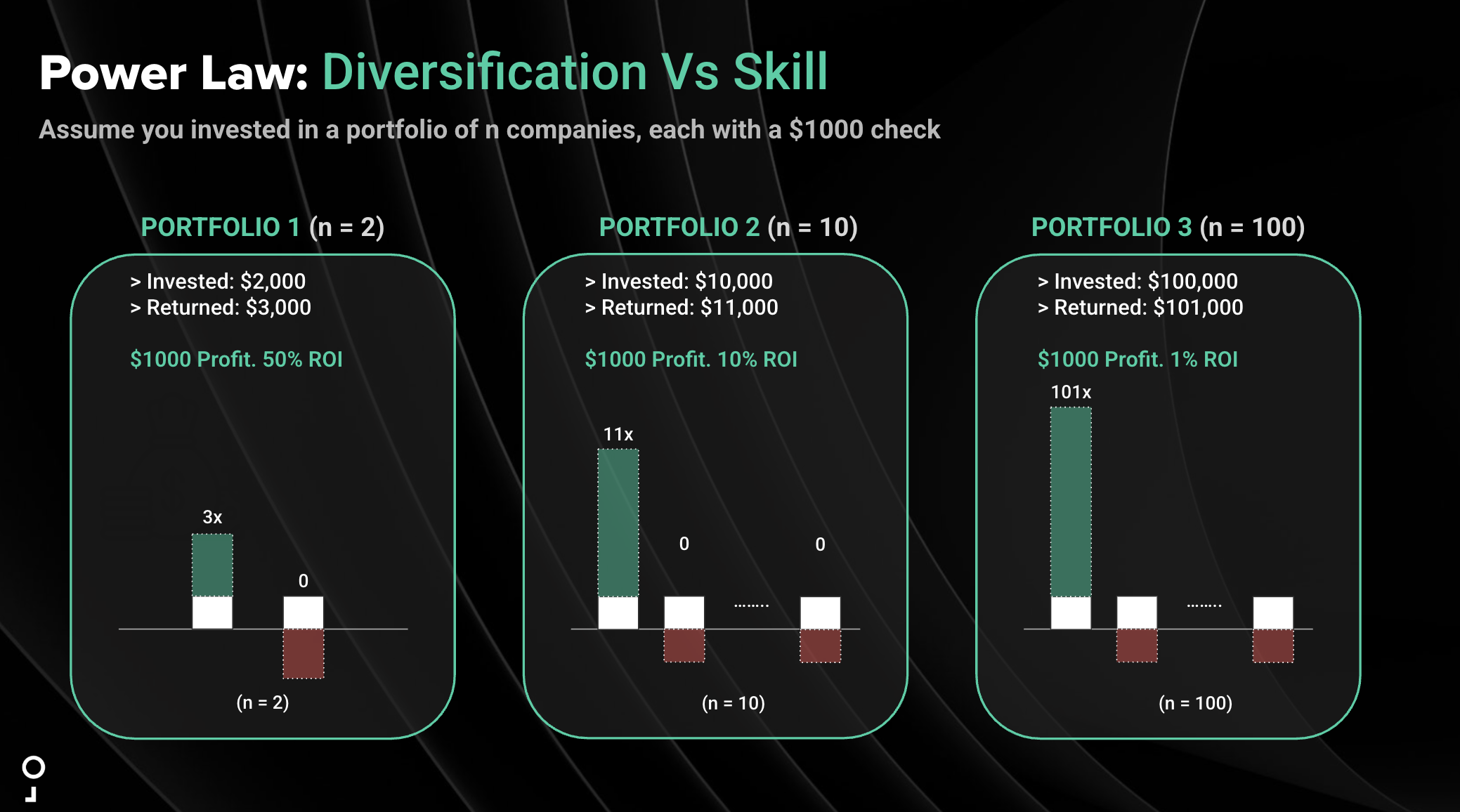
Power Law

The Power Law implies that you need to make multiple bets in order for the math to work in your favor. This naturally increases diversification levels through exposure to multiple companies, while also reducing idiosynratic risk.

Fish Schools act as "micro portfolios" for domain experts to invest together. This enables a more scalable mechanism for investors to receive sufficient diversification in private markets, without one individual bearing the entire burden of diligence and sourcing upfront or the full responsibility of sheparding the company to exit down the road. Instead, investors work together to save time and money, while naturally improving their own individual diversification breadth across private investments.

Furthermore, investors can mitigate market timing risk by leveraging Fish Schools to dollar cost average(DCA) into private markets over a defined period of time(i.e. the deployment period).

Time and Cost Efficiency for Managers and LPs

Traditional SPVs and fund structures incur repeated overhead per transaction:

  • Legal formation
  • Subscription processing
  • Compliance verification
  • Administrative coordination
  • Jurisdictional tax differences
  • Accounting and distribution management

Costs scale more efficiently when you can amortize these costs over time, and across individual deals, through shared programmable infrastructure. Compliance is embedded. Custody is native. Distributions are deterministic.

The next time you decide to form an SPV and pay $10k+ in admin fees - pause.

The next time you decide to participate in an SPV, pay carried interest, and concede future voting rights - pause.

Then, create an account on Fish Network.

Optionality that Builds Investor Confidence

Fish Network gives investor ecosystems and emerging managers the collaborative toolkit institutions have long monopolized, enabling shared due diligence, pooled capital, and diversified exposure without million-dollar minimums or decade-long lockups.

Unlike direct investing, which demands full conviction and high deployment minimums, or funds locking capital for 7-10 years with limited control, Fish Schools let investors participate together across multiple deals with smaller individual check sizes. This creates portfolio-level optionality: choose schools by sector (ex. AI, biotech), stage (ex. pre-seed), and risk profile. This gives investors more alternative exit pathways, through secondary auction markets today, and structured optional liquidity via redemption windows in the future.

In this model:

  • Deal selection: Vote on opportunities collectively rather than betting blindly on single companies
  • Capital deployment: Deploy into multiple deals at once via Fish Schools, with the option to invest directly
  • Time horizon: Shorter deployment cycles than funds with pre-defined exit criteria.
  • Manager diversity: Back emerging GPs through schools rather than picking one "star" manager
  • Geography & access: Global deal flow without relocation or network limitations

Fish Schools create unmatched flexibility:

  • Select schools by thesis, risk tolerance, or Fish School Organizer reputation.
  • Scale positions dynamically using real-time performance data
  • Clear pathways for systematic exit via milestone triggers, or human-led secondary market auctions
  • Build track record collaboratively, not individually

Collaboration as a Competitive Advantage

For established VCs, Fish Network offers:

  • A mechanism to evaluate talent through independent School P&Ls
  • Optionality in allocating capital across internal and external managers
  • A structured way to retain and scale high performers
  • Diversification across distinct judgment profiles

For emerging managers, it offers:

  • A path to build track record without immediate fund formation
  • Access to shared diligence resources
  • Lower operational overhead
  • Transparent capital coordination

For LPs, it offers:

  • Diversification across multiple Schools
  • Reduced key-person risk
  • Visibility into decision-making processes
  • Measurable attribution rather than narrative reporting

Collaboration mechanics become shared infrastructure that drives returns, not just marketing language to convince LPs to invest.

Through superior diversification tactics, structured optionality, and more cost efficient infrastructure, Fish Network enables the solo capitalist to scale, without being bogged down in ops, diligence, or compliance.

If you're a syndicate lead looking for an edge or a pivot, or an angel investor tired of paying carry, drop us a line today at [email protected]. Happy fishing!

The Next Layer of Crypto: Fish Network

· 13 min read
Fish Network
Fish Network Team

Since the genesis of crypto over a decade ago, the majority of existing crypto market participants have focused largely on currency creation (i.e. minting new tokens) and price speculation, rather than smart contract creation. Due to this fact, crypto technologies have struggled to achieve main-stream acceptance, mainly due to negative stigma around bankruptcies, hacks, and lack of enforceable compliance standards.

The Rise of Neofunds: Democratizing Private Markets

· 5 min read
Fish Network
Fish Network Team

Neofunds represent the market evolution away from traditional fund administrators and after-the-fact compliance cleanup efforts, towards digitally native, transparent, and lower cost investment vehicles for emerging managers and investor ecosystems. By applying the Neobank playbook to the buy-side within private markets, Neofunds will proliferate and scale atop software-native systems that embed compliance into its operational workflows. Neofunds have the potential to simplify operations for emerging managers, and streamline retail access to venture capital, private equity, real estate, and private credit, without altering securities laws or accreditation barriers.

Neofunds is a new marketing term, created by Fish Network, to describe the inevitable permiation of well understood Neobank characteristics to the buy-side broadly and private market microfunds specifically.